


 English
 русский
 Español
 简体中文
简体中文
From solutions to productions, we’re specialized in making the products you need.
Home / News / Industry News / ULPA Air Filter Guide: Efficiency, HEPA vs ULPA Comparison, and Selection Tips
Content
A 0.12-micron particle sits right at the most penetrating particle size for HEPA filter media—the point where HEPA efficiency is lowest. In a semiconductor fab, that one rare particle can ruin an entire wafer. In a hospital pharmacy compounding area, it can contaminate an IV preparation. ULPA air filters exist for exactly these situations. Short for Ultra-Low Penetration Air (also referred to as Ultra-Low Particulate Air in some references), ULPA describes a family of filters defined in EN 1822 as classes U15, U16, and U17, with minimum collection efficiencies of 99.999%, 99.9999%, and 99.99999% at their most penetrating particle size. Compared with HEPA, ULPA adds a meaningful margin of safety for critical environments—but it also adds pressure drop, weight, and cost. Choosing between them is not about picking the “better” filter; it is about matching performance to the actual contamination risk.
ULPA certification is defined by test standards, not by media type. Under EN 1822:2019, the ULPA classes are U15, U16, and U17. Efficiency is measured at the most penetrating particle size, or MPPS, which for typical ULPA filter media falls between 0.1 and 0.2 microns. The corresponding ISO 29463 ratings are ISO 45 H, ISO 50 H, and ISO 55 H. In real terms, a U15 filter lets through no more than one particle per 100,000 at the hardest-to-capture size—a level that is difficult to visualize but essential in microelectronics and pharmaceutical manufacturing.
Three design choices make these efficiencies possible. First, the media: ULPA filters use ultra-fine glass microfibers, typically 0.5 to 2 microns in diameter, arranged in a dense nonwoven sheet. Second, the pleat geometry: pleat spacing is tighter and pleat depth is optimized to maximize media area in a given frame while keeping airflow uniform. Third, the sealing system: in high-grade ULPA filters, the pack is sealed into the frame with polyurethane or in a liquid-gel (knife-edge) channel to prevent bypass leakage around the media.
The collection mechanisms themselves are the same four that apply to all fibrous filters—diffusion for particles below about 0.1 microns, interception for mid-size particles, inertial impaction for larger particles, and electrostatic attraction when charged media are used. What makes ULPA different is simply that the finer fibers and denser structure make every mechanism work more efficiently. The same physics also explain the trade-off: a denser media bed means higher resistance, typically 250–400 Pa at rated airflow, which is roughly 50% to 100% higher than a comparable HEPA filter.
For years, the dividing line between HEPA and ULPA in Europe has been defined by EN 1822: HEPA covers H13 and H14, while ULPA covers U15 through U17. Efficiency at MPPS is the primary differentiator, but in practice it brings several secondary differences that matter just as much.
| Parameter | HEPA (H14) | ULPA (U15/U16/U17) |
|---|---|---|
| Efficiency at MPPS | ≥ 99.995% | ≥ 99.999% to ≥ 99.99999% |
| Typical particle size of interest | 0.3 μm (historical test size) | 0.1–0.2 μm (actual MPPS) |
| Media fiber diameter | 0.5–2.0 μm (typical) | Finer, denser media |
| Pressure drop at rated airflow | Baseline | 50–100% higher |
| Energy consumption per m³/h | Baseline | Higher, proportional to pressure drop |
| Typical applications | Cleanrooms (ISO 5–8), HVAC, medical | Semiconductor, compounding pharmacies, high-risk patient areas |
| Cost per filter element | Moderate | 1.5 to 3 times higher |
The most consequential difference is pressure drop. A ULPA filter with the same face area and airflow rate as an H14 filter will generally operate at a pressure drop of 250–400 Pa versus 150–250 Pa for HEPA. In an HVAC system, that translates directly into higher fan energy, larger motor sizing, and more heat gain to be handled by cooling coils. For systems where ULPA is genuinely necessary, these costs are justified; for general commercial ventilation, they are not. That is why HEPA remains the practical choice for most HVAC system filtration requirements, while ULPA is reserved for zones where a single penetrating event has an unacceptable consequence.
ULPA filters are not a general-purpose upgrade; they are specified where process or patient protection demands the lowest achievable particle penetration.
Cleanrooms. In semiconductor fabs and certain pharmaceutical manufacturing lines, yield and product quality depend on removing particles that HEPA might miss. A U15 or U16 filter installed at the terminal of a cleanroom ceiling creates an ISO-class environment with a wider safety margin against sub-0.2-micron contamination. Cleanroom designers also value ULPA for its lower penetration of airborne bacteria-carrying particles in aseptic filling lines. The cleanroom air filtration design page breaks down how filtration levels interact with cleanroom classification.
Hospitals and protective environments. Operating rooms, bone marrow transplant units, and burn wards often require filtration beyond HEPA to protect immunosuppressed patients from fungal spores and bacteria. ULPA filters, sometimes deployed in terminal units with gel-seal frames, provide the extra margin that infection control teams look for in high-risk zones. These applications are covered in more detail on the hospital-grade air purification page.
Laboratories and containment facilities. Animal research facilities, BSL laboratories, and pharmaceutical quality-control labs use ULPA in exhaust or supply paths where both the environment and the sample need protection. The same efficiency that protects a cleanroom also protects a sensitive analytical instrument from particulate interference.
Transportation and specialized equipment. Aircraft cabins, public transport ventilation, and certain industrial enclosures use compact ULPA-grade elements where space is constrained but air purity targets are high.
Choosing a ULPA filter is a system design exercise, not a parts selection exercise. Three decisions dominate.
The first decision is which ULPA class to specify. U15 gives 99.999% efficiency, U16 gives 99.9999%, and U17 gives 99.99999%. Each step roughly increases the required filter depth and adds 15% to 30% more pressure drop. For many contamination-sensitive processes, the difference between U15 and U16 matters only at the margin; the specification should be driven by a risk assessment, not by the comfort of having a “higher number.” If the air handling unit lacks fan headroom, a well-designed U15 can outperform a U17 that is starved of airflow.
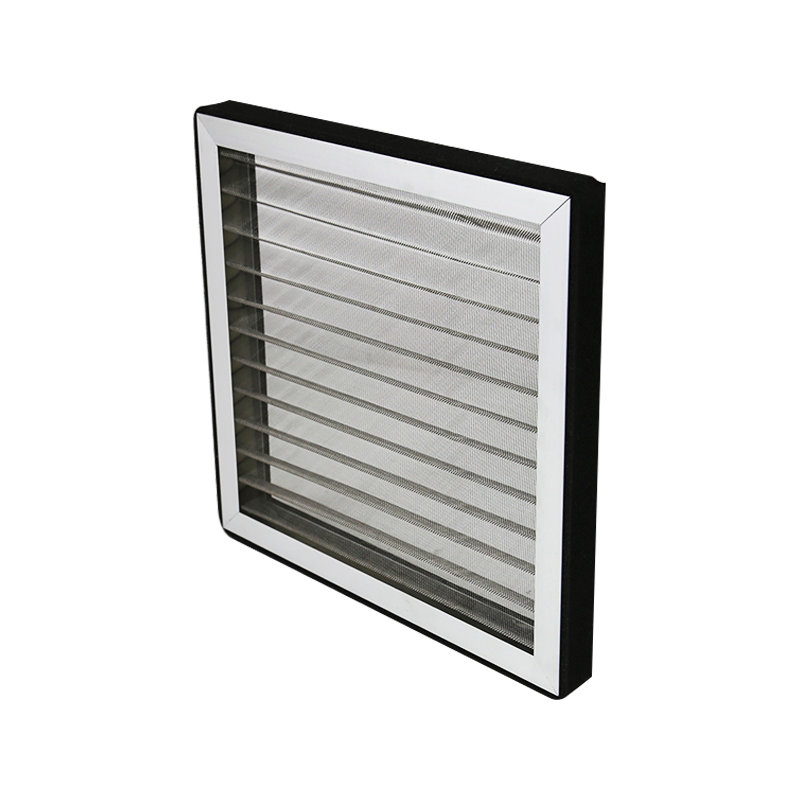
ULPA performance depends heavily on how the media pack is built and sealed. Separatorless pack construction, where the pleats are held open by small filaments rather than corrugated aluminum separators, is today’s standard for high-efficiency ULPA filters because it increases media area while keeping the pack compact. For applications with limited installation depth, separatorless mini-pleated high-efficiency filters offer the highest media density in a shallow frame.
Sealing is equally important. Gel-seal (knife-edge) frames, PU gaskets, and mechanical clamps each have their place. A filter that is efficient but poorly sealed in its housing will fail a scan test regardless of media quality. For cleanroom terminals where installation and removal happen from inside the clean zone, gel-seal housings with fluid-based sealing are often specified; the mini-pleated filters for cleanroom installations illustrate how pack design adapts to these terminal units.
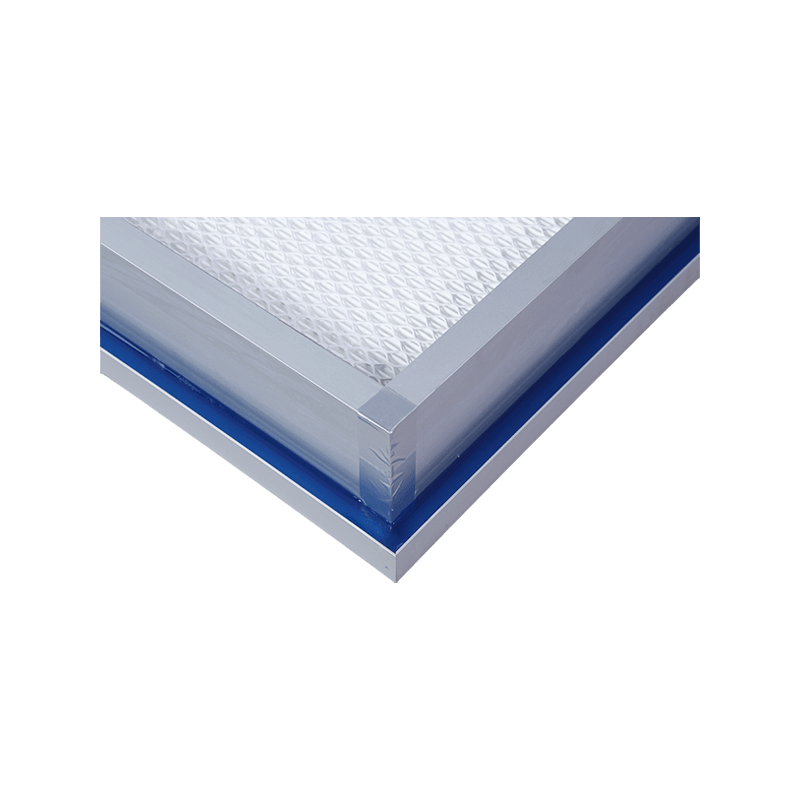 Mini-pleated Air Filters Suppliers, Company - Nantong Henka Environment SolutionNantong Henka - Mini-pleated Air Filter Suppliers and Company in China, Wholesale Mini-pleated Air Filters, This type of air filter is ma...View Product →
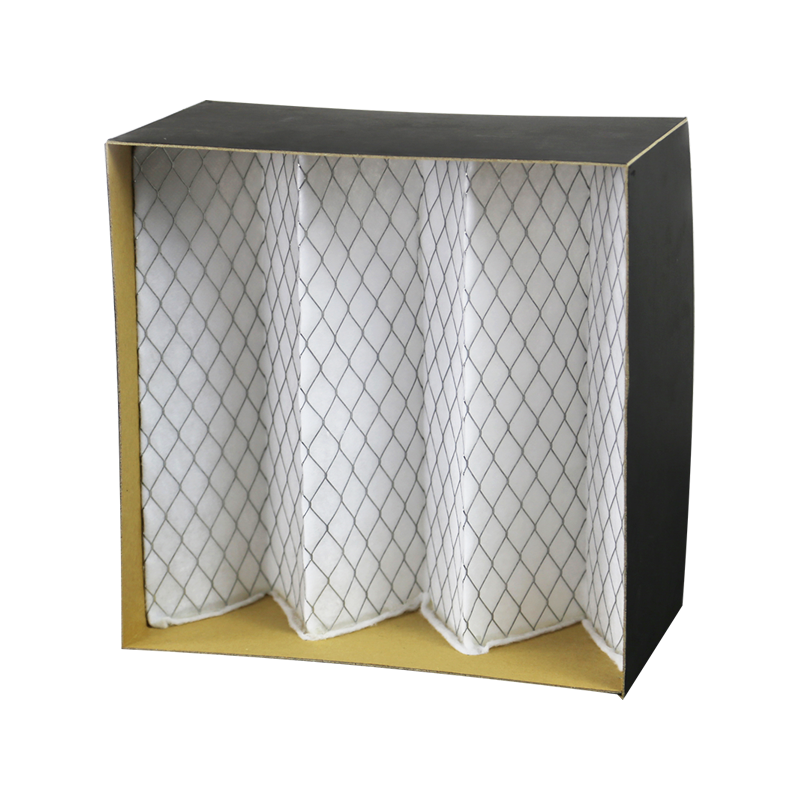
For high-airflow applications such as large HVAC air handling units and process ventilation, surface area becomes the limiting factor. A V-bank configuration, in which several mini-pleat packs are arranged in a V shape to multiply the effective media area, keeps face velocity low and pressure drop manageable. V-bank high-airflow filter designs are commonly used in this role, particularly where the filter bank must fit into a standard 610 mm or 305 mm frame depth.
 V-Bank / W Type Paper Card Frame Combined High Air Flow Air Filters Suppliers, CNantong Henka - V-Bank / W Type Paper Card Frame Combined High Air Flow Air Filter Suppliers and Company in China, Wholesale V-Bank / W T...View Product →
ULPA manufacturing is inherently more demanding than HEPA production. A single pinhole, a damaged pleat, or an imperfect seal can lower real-world efficiency by orders of magnitude. Reliable suppliers therefore test every filter individually, scanning the entire face with a calibrated particle counter and certifying the penetration level of each unit. When comparing suppliers, ask for the test certificate that accompanies each filter, and confirm which standard the test was performed against (EN 1822 or ISO 29463).
Customization is the second area to probe. ULPA filters are rarely an off-the-shelf product. Dimensions, frame material (aluminum, galvanized steel, PVC, or plastic), gasket type, pleat spacing, and even filter depth can all be adjusted to fit a specific housing. A manufacturer with in-house pleating and frame fabrication capacity will be substantially easier to work with when non-standard sizes are required, and they will be able to produce samples quickly for validation in your own test rig.
Finally, look for the supporting infrastructure of a reliable supplier: ISO 9001 for quality management, ISO 14001 for environmental management, and where applicable, UL certification on product lines. A manufacturer that has supplied filters to industries such as cleanrooms, hospitals, and fresh-air systems over a long period will have accumulated production records and field experience that are difficult to replicate in a short time. For any project that depends on consistent ULPA-grade performance, that history matters as much as the labeled efficiency.
HEPA Filter Micron Size Explained: Why 0.3 Microns Is the Performance Standard
What Does a Dirty HEPA Filter Look Like? Visual Signs and When to Replace














Copyright 2023 Nantong Henka Environment Solutions Co.,Ltd. All Rights Reserved
 HEPA Air Filters Manufacturers Customized HEPA Air Filters Factory
 Tel: +86-13813766750
 E-mail:
  Add: 5169, Bin'gang Ave, Binjiang Subdistrict, Haimen City, Jiangsu, China