


 English
 русский
 Español
 简体中文
From solutions to productions, we’re specialized in making the products you need.
Home / News / Industry News / Activated Carbon Air Filter Media: A Practical Selection Guide for OEMs
Content
Activated carbon air filter media is the gas-phase half of a filtration story that is often told only in particles. A filter can pass a dust test and still let cooking odors, formaldehyde, or traffic exhaust slip into the room. Carbon closes that gap, but only when the form of the media matches the way air actually moves through the device.
We have supplied custom filter elements to air purifier and ventilation brands since 2004. In that time, the same lesson keeps repeating: carbon is not a magic ingredient. It is a design variable. The useful question is not “does this filter contain carbon?” but “which carbon form, at what loading, in what housing, against which gas?”
Activated carbon is a porous carbon material with an enormous internal surface area. A single gram can carry hundreds to more than a thousand square meters of pore surface. Those pores capture gas molecules through adsorption, a surface phenomenon in which molecules stick to the carbon rather than being absorbed into it.
Micropores, generally under two nanometers, do most of the work on volatile organic compounds such as benzene, toluene, and xylene. Mesopores handle larger molecules and can influence how quickly a gas reaches the inner pore network. The practical capacity of the media depends on concentration, temperature, relative humidity, and residence time. A carbon filter that works well in a dry laboratory may struggle in a humid bathroom or a hot kitchen hood.
Plain carbon is excellent for many organic vapors and odors, but it is not equally good at everything. Ammonia, hydrogen sulfide, and formaldehyde often benefit from impregnated carbon. Impregnants such as potassium iodide, phosphoric acid, or potassium permanganate add a chemical reaction step alongside physical adsorption. That can improve capture of specific gases, but it also narrows the operating window: the wrong humidity or temperature can shorten life or create unwanted by-products.
One boundary deserves repeating. Activated carbon media is not a substitute for a particle filter. It has little ability to capture fine dust, and a dust-loaded carbon bed loses access to its pores. A pre-filter is not an accessory; it is part of the carbon system.
Most activated carbon starts as coconut shell, coal, wood, or another carbon-rich precursor. The raw material is carbonized, then activated with steam or chemicals to open the pore structure. Coconut shell carbon is dense and hard, which suits loose-fill cartridges and applications where attrition is a concern. Coal-based carbon can offer a broad pore distribution at a lower cost. Wood-based carbon may have a different pore profile and is common in decolorization, though air filtration uses it less often.
The finished carbon is then packaged into a form that can survive real airflow. The same activated carbon powder can become a granular bed, a pressed pellet, a honeycomb block, a coated nonwoven, or a cast foam. Each form changes pressure drop, capacity per unit volume, and resistance to vibration.
| Media form | Typical use | Strength | Watch-outs |
|---|---|---|---|
| Granular carbon | Loose-fill cartridges, drum filters, some industrial housings | High carbon loading and good access to gas | Can settle or channel; needs containment and a dust barrier |
| Pelletized carbon | Canisters, cabin filters, compact vapor cartridges | Low dust and predictable packing | Higher pressure drop than honeycomb at the same depth |
| Honeycomb carbon block | HVAC panels, air purifiers, cabin air, V-bank filters | Low pressure drop and self-supporting structure | Lower bulk density; edge sealing must be clean |
| Carbon nonwoven or felt | Thin composite filters, pre-filters, pleated media | Easy to combine with particulate media | Limited carbon loading and earlier breakthrough |
| Activated carbon foam | Household purifiers, range hoods, shaped air paths | Lightweight and conformable to complex housings | Low carbon loading; needs careful compression sealing |
| Impregnated carbon | Ammonia, hydrogen sulfide, formaldehyde, ozone control | Targets gases that plain carbon handles poorly | Impregnant selection matters; disposal and humidity limits |
In HVAC filtration, the carbon stage usually has to earn its place without wrecking the fan curve. Honeycomb blocks and V-bank carbon filters are common because they offer a large face area at a modest pressure drop. The carbon depth, cell density, and seal quality determine whether air actually passes through the media or finds a path around it. A bypass gap of a few millimeters can undo a carefully specified carbon bed.
 Custom Honeycomb Activated Carbon Filter for Air PurificationA customizable honeycomb carbon filter with plastic or paper cells and adjustable carbon filling, letting buyers tailor media and fit for air purification needs.View Product →
For household air purifier filters, space is tight and the carbon often travels with a HEPA stage. A cylindrical cartridge can wrap carbon around the particle filter, while a flat panel may use a carbon nonwoven or a thin honeycomb layer. The design challenge is dwell time. Air moving at high face velocity may cross the carbon in a few hundredths of a second, so the media needs high activity and good accessibility, not just a thick layer.
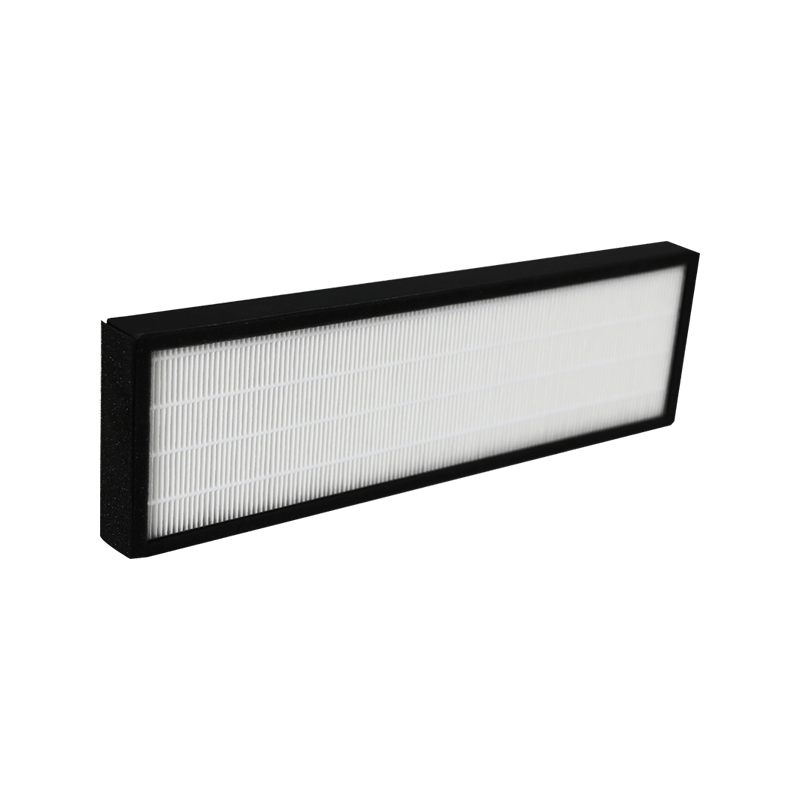 Combined HEPA and Activated Carbon Air FilterA combined HEPA and carbon filter for particle, formaldehyde, VOC, and odor removal, with frame and customization options for household air-purifier designs.View Product →
Cabin air filters face similar constraints with more vibration and wider temperature swings. Thin carbon nonwovens and impregnated media are common because they can be pleated into a compact housing. Industrial and commercial kitchen applications usually need a grease pre-filter first; carbon then handles odor and organic vapors, but it cannot be expected to survive heavy grease loading.
A carbon data sheet can be a dense forest of numbers. Three descriptors are worth understanding: iodine number, carbon tetrachloride activity, and butane working capacity. They are useful indicators of pore volume and adsorption activity, but they do not replace a test with the gas you actually need to remove. A media with a high iodine number may still be a poor choice for ammonia if it lacks the right impregnant.
For gas-phase filters, performance should be discussed in terms of capacity at a stated challenge concentration, airflow, temperature, and humidity. Pressure-drop curves at the intended face velocity are equally important. Ask for the media safety data sheet, dust content, and any relevant fire or disposal information. ISO 10121 and ASHRAE 145.1 are among the test frameworks used in the industry; the right one depends on whether you are evaluating media or a complete device.
Formaldehyde and total VOC removal deserve a separate look because the target gases behave differently. A carbon hanging module or a formulated carbon panel can be a practical choice in panel-style housings where a loose fill would be difficult to contain.
 Carbon Hanging Filter for Formaldehyde and TVOC RemovalA carbon hanging-process filter with chemically modified columnar carbon and flexible shaping for formaldehyde, TVOC, and odor removal in plate or cylindrical formats.View Product →
We usually recommend starting with a small sample matrix rather than a single “best” media. Two carbon forms, one pre-filter option, and a realistic challenge gas can reveal more than a stack of supplier claims. Our team has spent years building these comparisons into custom filter programs, and the work is usually more about asking the right questions than finding a universal answer.
No. HEPA captures particles; carbon captures gases and odors. Many effective filters combine both, with the particle stage placed upstream to protect the carbon.
There is no single answer. Life depends on gas concentration, humidity, temperature, airflow, and carbon mass. A filter in a clean office may last far longer than the same filter in a nail salon. Use a conservative change schedule and confirm it with field experience.
Generally no. Washing may remove dust, but it does not restore occupied adsorption sites. Moisture can also reduce performance and encourage biological growth. Replace the media instead.
Not automatically. More carbon can add pressure drop, weight, and cost. The right amount depends on the gas challenge and the available contact time. A thinner, more accessible bed can outperform a thick, poorly sealed one.
If you are planning a carbon stage for a new purifier, a ventilation retrofit, or a cabin air filter, the most productive first step is a clear description of the gas problem and the airflow budget. Send us the target gases, housing dimensions, expected face velocity, and operating conditions. We can suggest a starting media form, flag the pre-filter requirement, and build samples that let the design team test the real thing rather than a brochure number.














Copyright 2023 Nantong Henka Environment Solutions Co.,Ltd. All Rights Reserved
 HEPA Air Filters Manufacturers Customized HEPA Air Filters Factory
 Tel: +86-13813766750
 E-mail:
 Add: 5169, Bin'gang Ave, Binjiang Subdistrict, Haimen City, Jiangsu, China