


 English
 русский
 Español
 简体中文
简体中文
From solutions to productions, we’re specialized in making the products you need.
Home / News / Industry News / HEPA Filter Micron Size Explained: Why 0.3 Microns Is the Performance Standard
Content
When a specification sheet says "99.97% at 0.3 microns," the natural instinct is to read it as a pore size: a filter media with openings just small enough to stop particles larger than 0.3 microns, like a sieve. That reading is understandable but incorrect. The 0.3 micron figure is a test point, not a physical cutoff. It describes the most penetrating particle size, the particle diameter at which a HEPA filter performs worst. If a filter achieves 99.97% efficiency at that worst-case size, it will capture particles both larger and smaller with equal or better efficiency. Understanding this distinction matters because it changes how you compare air purifier filters, HVAC filters, clean room panels, and fresh air system cartridges.
HEPA efficiency is officially rated at the most penetrating particle size, or MPPS. The MPPS is not a fixed number printed on the media; it depends on fiber diameter, media density, and airflow velocity. For most glass-fiber and synthetic HEPA media operating at normal face velocities, the MPPS falls somewhere between 0.15 and 0.3 microns. The classic 0.3 micron value was adopted by industry standards because it represents the difficult middle zone where capture by physical mechanisms is weakest.
The physical reason is straightforward. Large particles are caught by inertial impaction because they are too heavy to follow the air stream around a fiber. Medium particles are caught by interception when they graze a fiber surface. Very small particles are caught by diffusion because Brownian motion pushes them into fibers. Around 0.3 microns, none of these mechanisms is working at full strength. A particle of this size slips through more easily than any other, which is exactly why it is used as the test point.
A HEPA filter is not a simple membrane. It is a dense, randomly arranged mat of microfibers with a large internal surface area. Particle removal happens through four mechanisms:
The combined result is an efficiency curve that dips at the MPPS and rises on both sides. That is why a HEPA filter rated at 99.97% for 0.3 micron particles can still remove smaller particles, including many virus-carrying droplets, at a percentage higher than the stated rating.
Different standards define HEPA classes by efficiency at the MPPS, not by physical pore diameter. The most common references are EN 1822 in Europe, ISO 29463 internationally, and IEST-RP-CC001 in many North American specifications. The table below shows the classification used for ventilation and clean room filters.
| Class | Minimum efficiency at MPPS | Allowable penetration | Typical applications |
|---|---|---|---|
| H13 | 99.95% | 0.05% | Medical, pharmaceutical, premium air purifiers |
| H14 | 99.995% | 0.005% | Clean rooms, operating rooms, containment |
| U15 | 99.9995% | 0.0005% | Semiconductor, ultra-clean processes |
| U16 | 99.99995% | 0.00005% | Critical clean rooms, nuclear containment |
The difference between H13 and H14 is often misunderstood as a small percentage gap. In fact, the allowable penetration drops from 0.05% to 0.005%, a ten-fold reduction. This matters in pharmaceutical clean rooms, hospital isolation rooms, and laboratories where the filter is the final protection barrier. For most commercial and residential air cleaning applications, both classes perform well, and the better decision usually comes down to pressure drop, media area, and frame construction rather than the last decimal of the efficiency claim.
Putting the 0.3 micron benchmark next to common airborne particles makes the specification easier to explain to customers, colleagues, or end users.
| Particle | Typical diameter | HEPA capture behavior |
|---|---|---|
| Human hair | 50 to 150 microns | Captured well above the 0.3 micron range |
| Visible dust | 10 to 100 microns | Captured efficiently by impaction and interception |
| Pollen | 10 to 40 microns | Captured efficiently |
| Mold spores | 2 to 10 microns | Captured efficiently |
| Bacteria | 0.3 to 10 microns | Smallest bacteria sit at the MPPS |
| PM2.5 combustion particles | 0.1 to 2.5 microns | Captured with high efficiency |
| Virus particles | 0.02 to 0.3 microns | Captured by diffusion, often in droplets or clusters |
The smallest bacteria sit near 0.3 microns, which is one reason the benchmark became standard in medical filtration. Viruses are smaller as individual particles, but they rarely circulate alone. They travel inside droplets, on dust, or in aggregates, and HEPA media captures these carriers effectively. A filter that passes the 0.3 micron test is not limited at 0.3 microns; it is verified at the size where it is least efficient, which is exactly the information you want from a test.
The term HEPA is protected by regulation in some regions and used more loosely in others. In Europe, a filter sold as HEPA must meet at least EN 1822 H13. In other markets you will come across labels such as HEPA-like, HEPA-type, or 99% HEPA. These terms have no fixed standard. The claimed efficiency may have been measured at a different particle size, at a lower airflow, or by the manufacturer's own method. For this reason, buying a filter without examining the underlying test data is a real procurement risk.
Before you approve a filter supplier, ask:
These details are particularly important for OEM buyers, because the filter specification becomes part of the finished device's compliance and warranty obligations.
Once the micron rating is clear, the next decision is mechanical: which frame, pleat geometry, and media area fit the device and its airflow. A filter that performs perfectly on a test bench can still fail in service if the pressure drop is too high for the fan or if the sealing method does not match the housing.
Household air purifiers operate with low-pressure fans inside compact housings, so the priority is a large media area in a small volume and a moderate initial resistance. Cylindrical and panel formats are common because they wrap more media into a limited footprint; the cylindrical air filter for household air purifiers is a typical format used in this class of appliance. A coarse pre-filter layer in front of the HEPA media also extends service life by stopping lint and larger dust before they load the fine media.
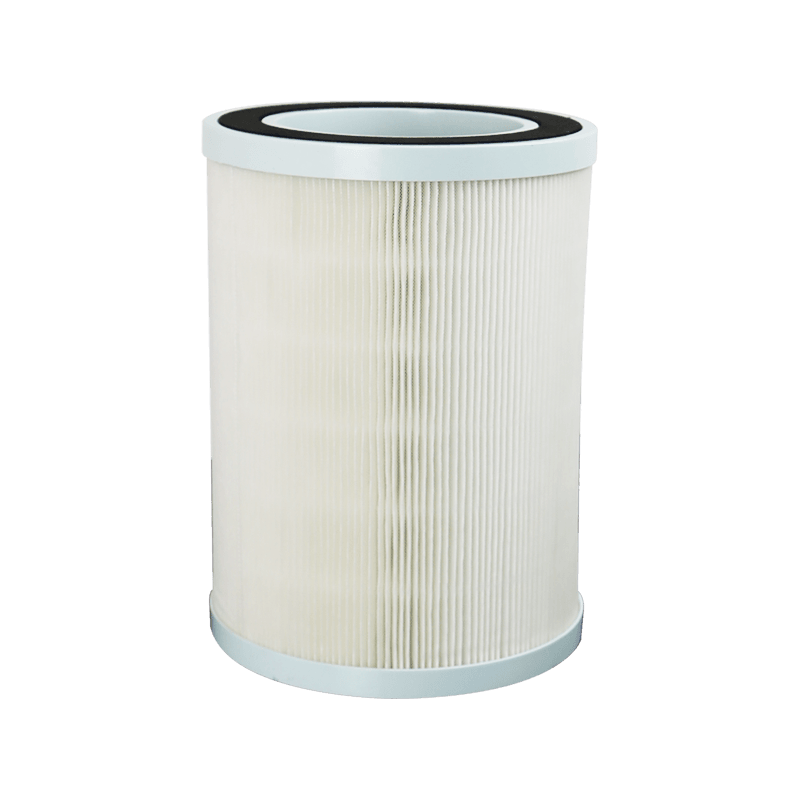 Cylindrical Air Filters for Household Suppliers, Company - Nantong Henka EnvironNantong Henka - Cylindrical Air Filter for Household Suppliers and Company in China, Wholesale Cylindrical Air Filters for Household, The...View Product →
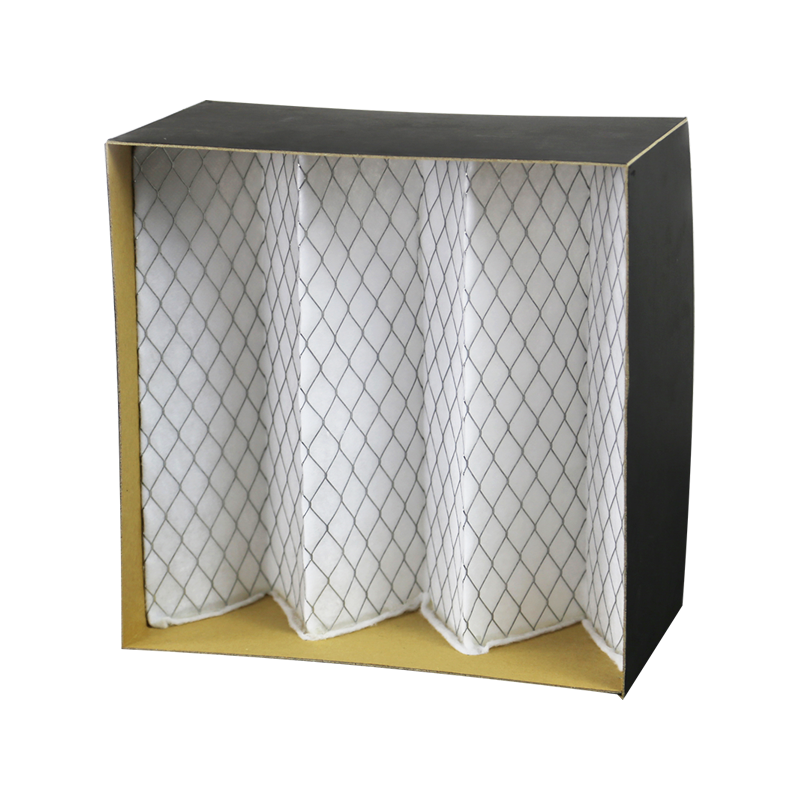
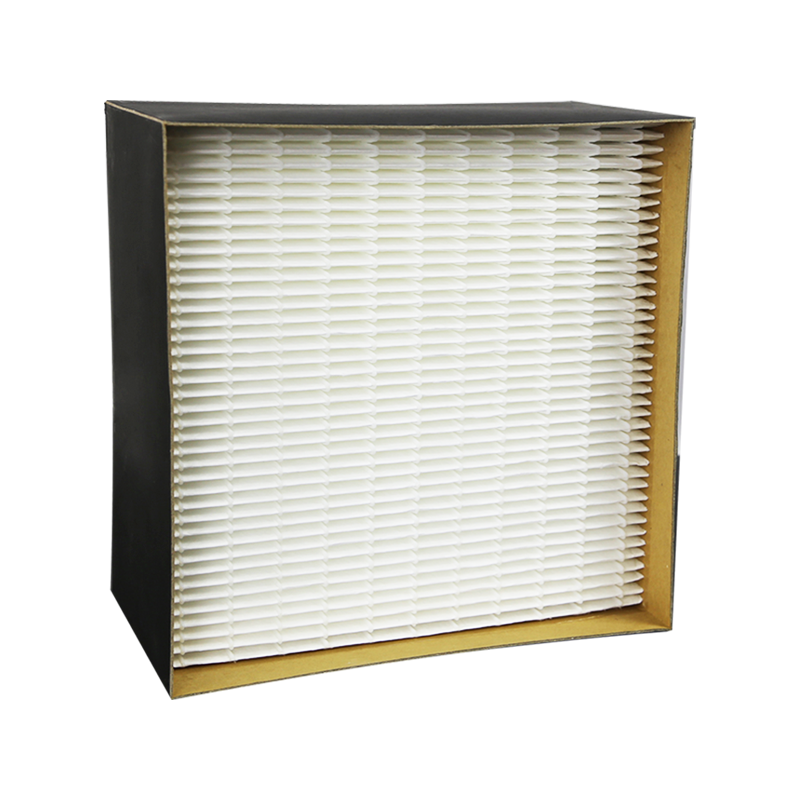
HVAC and fresh air systems place the filter in a duct where airflow is continuous and space is often tight. A V-bank geometry gives the designer more media area in a shallow frame, reducing face velocity and pressure drop at the same airflow. The benefits of large-area media design in HEPA air filters are well documented, and this is why commercial HVAC filter installations continue to favor high-capacity V-bank and mini-pleat configurations. A paper-frame V-bank combined high air flow filter is a practical example of a high-airflow HEPA filter in a lightweight frame.
 V-Bank / W Type Paper Card Frame Combined High Air Flow Air Filters Suppliers, CNantong Henka - V-Bank / W Type Paper Card Frame Combined High Air Flow Air Filter Suppliers and Company in China, Wholesale V-Bank / W T...View Product →
Clean rooms, laboratories, and hospital areas are a different case. Certification and seal integrity matter more than cost, because the filter is part of a validated environmental process. Mini-pleated filters with rigid frames are commonly scanned and tested individually before installation. The mini-pleated air filter for clean room filtration is built precisely for this kind of duty.
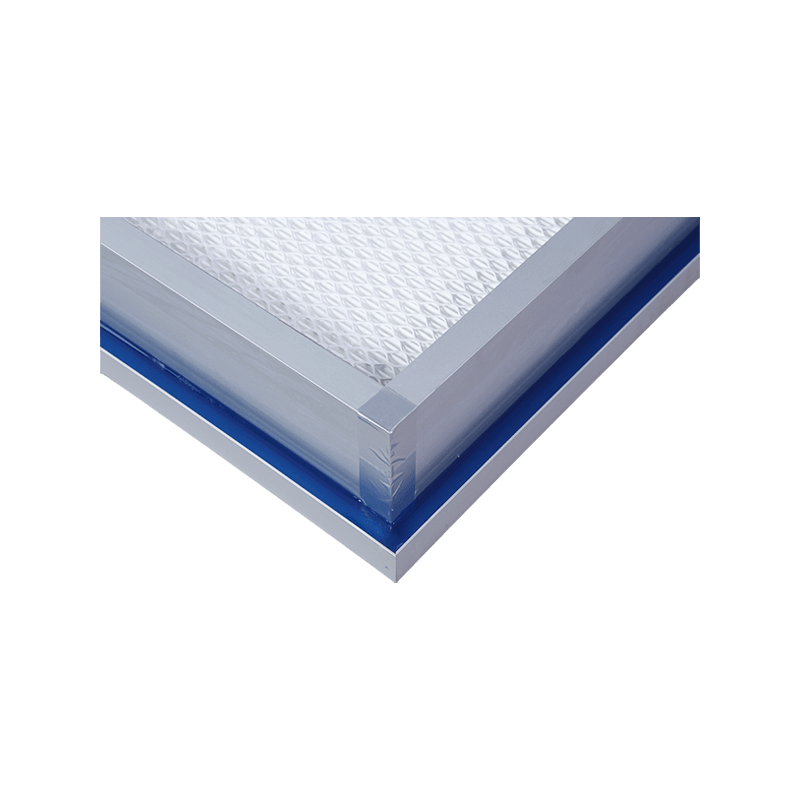 Mini-pleated Air Filters Suppliers, Company - Nantong Henka Environment SolutionNantong Henka - Mini-pleated Air Filter Suppliers and Company in China, Wholesale Mini-pleated Air Filters, This type of air filter is ma...View Product →
The micron number printed on a HEPA filter is a test point, not a sieve opening. The 0.3 micron benchmark exists because it is the hardest particle size for the media to capture, and passing the test at that point means the filter performs at least as well on every other size. When you compare filters, compare the verified efficiency class, the airflow at which it was tested, the pressure drop, and the construction quality. Suppliers who can document those details will save you far more money and trouble than any marketing claim about a smaller micron number.
HEPA Filter Construction: Media, Design, and Application for Construction Dust
ULPA Air Filter Guide: Efficiency, HEPA vs ULPA Comparison, and Selection Tips














Copyright 2023 Nantong Henka Environment Solutions Co.,Ltd. All Rights Reserved
 HEPA Air Filters Manufacturers Customized HEPA Air Filters Factory
 Tel: +86-13813766750
 E-mail:
  Add: 5169, Bin'gang Ave, Binjiang Subdistrict, Haimen City, Jiangsu, China