


 English
 русский
 Español
 简体中文
From solutions to productions, we’re specialized in making the products you need.
Home / News / Industry News / Do HEPA Filters Remove Smoke? Yes for Particles, No for Odors - Here's Why
Content
Smoke drifts into the living room from the kitchen, from a neighbor's balcony, or through the window during wildfire season. Within minutes, the smell has reached the curtains, the sofa, and the clothes in the closet. The question that shows up again and again in air purifier discussions is straightforward: do HEPA filters remove smoke? The short answer is yes for smoke particles, but no for the gases that cause the lingering odor. Understanding that distinction matters before you buy a filter, design a purifier, or specify a filtration system for a building.
HEPA filters are mechanical barriers engineered to capture airborne particles, and smoke contains plenty of them. A true HEPA filter tested under EN 1822 captures at least 99.95% of particles at the most penetrating size, which sits near 0.3 microns. The classic US DOE rating describes the same performance as 99.97% at 0.3 microns. Smoke haze, soot, and condensed tar aerosols all fall into the size range HEPA handles efficiently.
The catch is that smoke is not only particles. It also contains gases such as formaldehyde, benzene, acrolein, and nicotine vapor, and those compounds are what your nose reads as smoke smell. Gas molecules are roughly a thousand times smaller than the openings in HEPA media, so they pass straight through. A HEPA-only filter clears the visible haze and reduces particulate exposure, but it will not make the smell disappear. Complete smoke removal requires pairing HEPA with activated carbon or another adsorption stage.
Smoke is not a single substance; it is a complex mixture of compounds in two distinct phases. Cigarette smoke alone contains more than 6,000 identified substances, split between a particulate phase and a gas phase. The particulate phase contains solid carbon, ash, tar, and heavy hydrocarbons. The gas phase contains volatile organic compounds (VOCs), aldehydes, and inorganic gases. HEPA only addresses the first group.
| Fraction | Examples | Typical size | Captured by HEPA? |
|---|---|---|---|
| Particulate matter | Soot, ash, char | 0.1 to 1 µm | Yes |
| Condensed aerosols | Tar, resin droplets | 0.3 to 1 µm | Yes |
| Gases and vapors | Formaldehyde, benzene, acrolein | 0.0003 to 0.001 µm | No |
Understanding the two-phase nature of smoke explains why so many smoke-oriented filters pair high-efficiency particle media with activated carbon. One layer is for the particles you can see and feel; the other is for the molecules you can smell. Removing both is what makes a room feel genuinely clean.
HEPA media is a dense mat of fine fibers arranged in a random structure. Particles are captured by three mechanisms that work together. Interception catches particles that brush against a fiber and stick. Inertial impaction catches larger particles that cannot follow the curved air path around a fiber and crash into it instead. Diffusion catches very fine particles, which move in a chaotic brownian motion pattern and collide with fibers as they wander through the media. All three mechanisms make HEPA highly efficient across a wide size range, and the gap between them, where no single mechanism is at its strongest, sits at about 0.3 microns. That is why standards test at that point.
Smoke particles from cigarettes, wildfires, and cooking typically fall between 0.1 and 1 micron, which puts them inside the strongest capture window for HEPA. Real-world performance still depends on airflow rate, pleat geometry, and seal integrity, but a genuine HEPA element with a properly sealed frame delivers what its rating promises.
The smell that clings to a room after smoking is produced by gas-phase molecules. Formaldehyde, acetaldehyde, benzene, toluene, and nicotine vapor have kinetic diameters in the range of 0.0003 to 0.001 microns. The gaps between HEPA fibers are orders of magnitude larger, so gas molecules pass through without being captured. HEPA removes the particulate fraction, but the gas phase keeps circulating.
Activated carbon is the standard solution for gas-phase smoke removal. Carbon is processed to create a porous structure with a large internal surface area, and gas molecules are held on that surface by van der Waals forces. The mass of carbon, the depth of the bed, the type of treatment, and the contact time all determine how long the adsorption layer stays effective. A thin carbon foam with a few grams of carbon will saturate in days; a proper carbon stage lasts for months under normal household use. This is why filter manufacturers combine the two technologies. A multifunctional activated carbon HEPA filter puts a particle stage and a carbon stage in one cartridge, so the purifier removes soot and odor in a single pass. For compact units that rely on a cylindrical cartridge geometry, a PCC HEPA cylindrical filter gives the same combined performance in a smaller footprint.
 PCC&HEPA Cylindrical Filters Suppliers, Company - Nantong Henka Environment SoluNantong Henka - PCC&HEPA Cylindrical Filter Suppliers and Company in China, Wholesale PCC&HEPA Cylindrical Filters, PCC&HEPA cylindri...View Product →
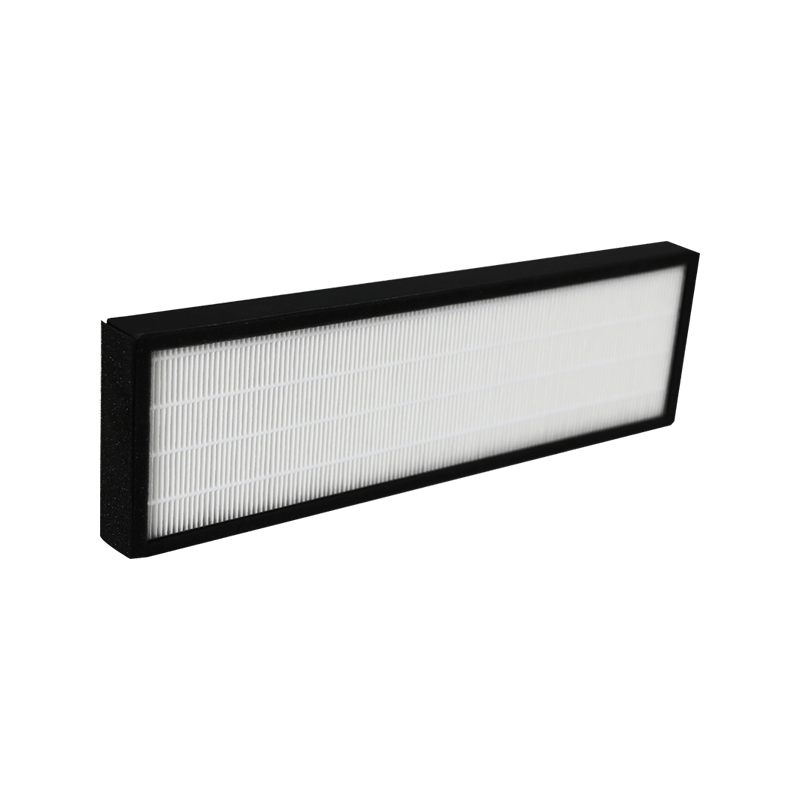 Multifunctional Activated Carbon HEPA Filters Suppliers, Company - Nantong HenkaNantong Henka - Multifunctional Activated Carbon HEPA Filter Suppliers and Company in China, Wholesale Multifunctional Activated Carbon H...View Product →
Not all smoke behaves the same way, so filter priorities change with the source.
Whether you are buying a replacement filter for a room purifier or specifying a filter for a new product, five factors decide how well the filter will perform in real conditions.
For ducted systems and central ventilation, the selection logic is identical, but installation quality matters even more. A loose filter in an equipment rack, or a media area undersized for the duct velocity, lets unfiltered air bypass the element and carries smoke straight downstream. Properly designed and sealed HVAC filtration is a prerequisite for smoke control in larger buildings.
For anyone developing a product for the household air purifier market, smoke performance is one of the first tests customers run. A purifier that clears cigarette smoke also handles cooking fumes, wildfire haze, and urban particulate pollution. The most reliable way to deliver that result is a filter design that pairs HEPA with a substantial carbon layer, because both stages fit in one serviceable component. Cylindrical household air purifier filters are widely used in this segment because the tall pleat pack delivers a large media area inside a compact cabinet, keeping the unit small while preserving long service life.
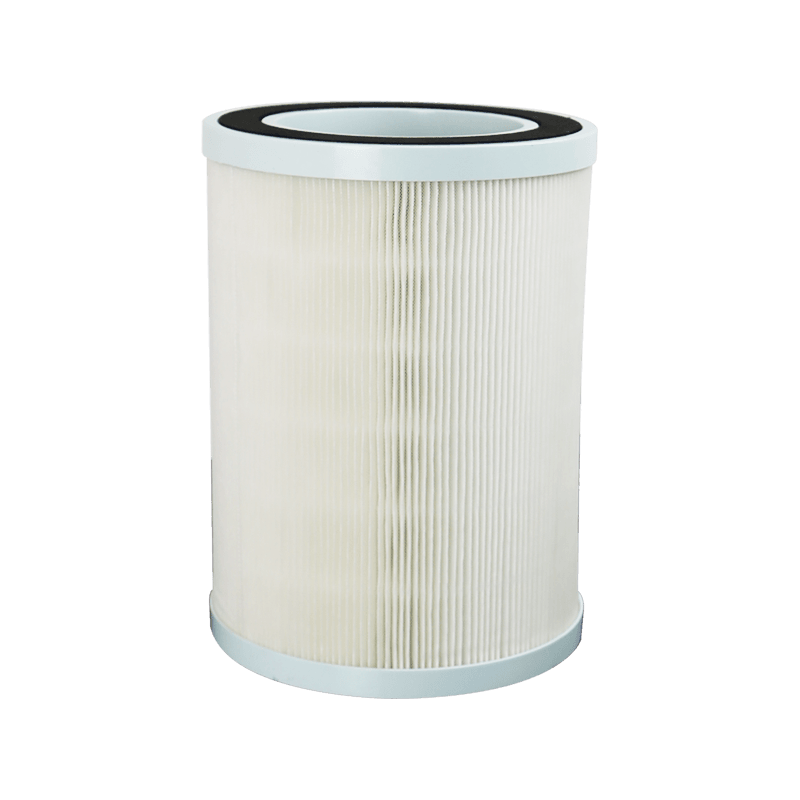 Cylindrical Air Filters for Household Suppliers, Company - Nantong Henka EnvironNantong Henka - Cylindrical Air Filter for Household Suppliers and Company in China, Wholesale Cylindrical Air Filters for Household, The...View Product →
The bottom line is consistent with the technical picture. HEPA filters do remove smoke particles, and high-quality HEPA media does so at 99.97% efficiency at the most demanding particle size. But smoke is a two-phase problem. The particulate phase responds to HEPA; the gas phase responds to activated carbon. When both stages are present, and when the filter is sealed correctly and matched to the airflow of the room or duct, the result is air that is not only visually clear but also free of the persistent smell that makes smoke unmistakable.














Copyright 2023 Nantong Henka Environment Solutions Co.,Ltd. All Rights Reserved
 HEPA Air Filters Manufacturers Customized HEPA Air Filters Factory
 Tel: +86-13813766750
 E-mail:
 Add: 5169, Bin'gang Ave, Binjiang Subdistrict, Haimen City, Jiangsu, China