


 English
 русский
 Español
 简体中文
From solutions to productions, we’re specialized in making the products you need.
Home / News / Industry News / Activated Carbon Filter Media: A Practical Guide to Selection and Performance
Content
Engineers often say “activated carbon filter media” as if it were one material. In practice, it is a family of adsorbents made from coconut shell, coal, wood, or other carbon-rich sources, each with different pore structures, binders, and surface treatments. Two filters can contain the same weight of carbon and still behave very differently in the field.
In our work with air purifier and ventilation manufacturers, the most useful conversation does not start with “Do you want carbon?” It starts with three questions: which gases need to be removed, how much space and pressure drop are available, and how long the filter must perform before replacement. Those answers shape the media choice far more than a generic “high-quality activated carbon” claim.
Activated carbon works mainly by adsorption. Gas molecules move into the carbon’s internal pore network and attach to the surface through weak forces. That is different from absorption, where a material takes another substance into its bulk volume. Activation creates a vast internal surface area, often in the range of several hundred to more than a thousand square meters per gram, which is why a relatively small carbon filter can hold a meaningful amount of odor and VOC mass.
The pore size distribution matters. Micropores are effective for small molecules, while mesopores help with larger organic compounds and improve access to the interior. Physical adsorption is reversible, so temperature and concentration changes can cause previously captured gases to desorb. Chemical adsorption, usually created by impregnating the carbon with a reactive agent, forms stronger bonds and is often used for ammonia, acid gases, ozone, or formaldehyde. Neither route makes carbon a particle filter. Carbon handles gases and odors; HEPA media handles particles. Many practical filters combine both because the contaminants usually appear together.
The same activated carbon can be delivered as loose granules, powder, pellets, beads, felt, honeycomb blocks, or corrugated sheets. The form affects pressure drop, dust, carbon loading, contact time, and how easily the filter can be assembled into a cylindrical cartridge or a flat panel.
| Form | Typical use | What to watch |
|---|---|---|
| Granular (GAC) | Packed beds, refillable cartridges, thick panels | Settling, channeling, dust, and vibration |
| Powdered (PAC) | Thin coatings and nonwoven blends | Dusting and limited contact time |
| Extruded pellets | Cartridges and chemical filters | Weight and pressure drop |
| Spherical beads | Low-dust cartridges and compact beds | Cost and packing density |
| Impregnated carbon | Ammonia, acid gases, ozone, formaldehyde | Impregnant loading and humidity sensitivity |
| Woven or felt carbon | Thin spaces and light-duty odor control | Low total capacity |
| Honeycomb or corrugated | Compact VOC and odor filters with low pressure drop | Carbon loading and short residence time |
Honeycomb and corrugated formats are popular in residential and light commercial air purifiers because they keep pressure drop manageable while allowing a large frontal area. The trade-off is that the air may spend very little time in contact with the carbon. Media selection and pleat or cell geometry have to be developed together.
 PCCHC Customizable Honeycomb Activated Carbon FilterFor honeycomb air-purifier designs balancing pressure drop and contact time, this filter uses plastic or paper cells with adjustable carbon filling.View Product →
Carbon datasheets are full of numbers that look precise but are not interchangeable. A high iodine number suggests a well-developed micropore structure, but it does not guarantee strong performance against a specific VOC mixture. CTC activity is useful for low-boiling organic vapors. BET surface area describes total surface area, yet some of that area may be inaccessible under real airflow conditions. Butane working capacity can be more relevant for solvent and odor service because it reflects working capacity rather than total porosity.
When comparing samples, look at the full package:
A media that wins on one headline number may lose in an actual filter if the contact time is too short or the binder blocks access to the pores. Challenge testing at the intended airflow, temperature, and humidity is more reliable than a datasheet comparison alone.
Different gases need different carbon. Standard high-surface-area carbon is a sensible starting point for many VOCs, solvent odors, and general indoor air odors. Formaldehyde is harder because it is small, reactive, and often present at low concentrations; impregnated or chemically modified media may be needed. Ozone is often handled with catalytic carbon, while ammonia and amines usually call for acid impregnation. Acid gases such as sulfur dioxide or hydrogen sulfide are better matched with alkali-impregnated products. Mixed gas streams introduce competitive adsorption, where one compound can occupy sites and reduce capacity for another.
Humidity is a practical constraint that deserves early attention. Water vapor competes for adsorption sites and can reduce organic vapor capacity, especially in humid climates or fresh-air systems. Temperature matters too: hot air lowers physical adsorption capacity and can promote desorption. A filter that performs well in a lab at 50% relative humidity may tell a different story in a bathroom, kitchen, or coastal installation.
 PCCN Carbon Hanging Process Activated Carbon FilterDesigned for plate and cylindrical filters, this carbon-hanging media targets formaldehyde, TVOC, and odors with a supported columnar carbon structure.View Product →
Carbon media must survive real assembly and real airflow. Loose granules need containment so they do not settle or vibrate into a low-density path. Powder coatings need a binder that does not shed into the airstream. Honeycomb blocks need edge sealing that prevents air from bypassing the carbon. Cylindrical cartridges need end caps and pleat or wrap structures that keep the media in place without adding unnecessary pressure drop.
For household air purifiers, compact cylindrical and plastic-comb formats are common because they fit round housings and support high-volume production. For fresh air systems, panel and V-bank formats often make more sense because they offer high airflow with predictable replacement. In both cases, the carbon can be combined with HEPA media to create a single filter that handles particles and gases together, but the combination must be designed so that the carbon is not overloaded or bypassed.
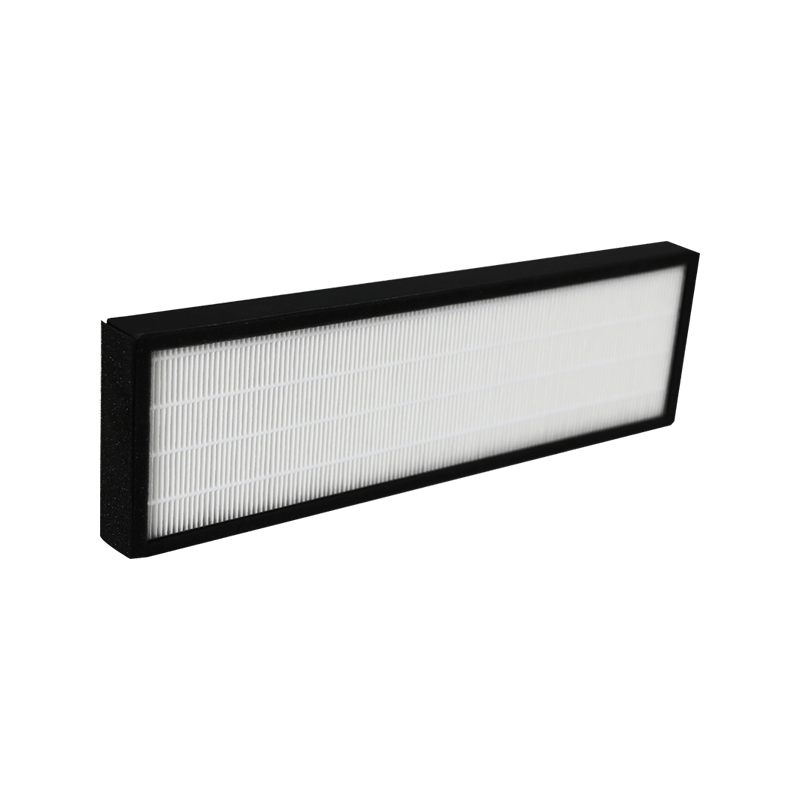 Multifunctional Activated Carbon HEPA FilterFor combined particle and gas filtration in purifiers or fresh-air systems, this HEPA and activated carbon filter targets 0.3-micron particles, formaldehyde, VOC, and odors.View Product →
Activated carbon has a finite capacity. Once the available adsorption sites are occupied, breakthrough occurs and efficiency falls. The practical lifetime depends on the gas concentration, airflow, humidity, temperature, and the amount of carbon in the filter. A small carbon pad in a kitchen hood and a deep V-bank chemical filter may use similar media but behave nothing alike.
A useful test plan starts with the challenge gas or gas mixture and uses the intended face velocity and humidity. Measure upstream and downstream concentration over time, not just at the start. Record pressure drop as the filter loads. If the application involves intermittent use, include desorption checks after standby periods. For residential products, field feedback about odor return, dust, and replacement intervals is just as valuable as a single lab efficiency number.
Carbon selection goes better when the media supplier and the filter manufacturer work from the same application brief. At Henka, we usually ask for the target gases, airflow, allowable pressure drop, housing dimensions, expected life, and any certification or documentation needs. From there, we can compare granular, honeycomb, corrugated, or combined HEPA-carbon constructions and build samples around the actual housing rather than a catalog page. Our factory has been producing custom air filters since 2004 and works within ISO 9001 and ISO 14001 systems, which helps keep media choice, assembly, and quality checks connected. The goal is not to sell the most carbon possible. It is to choose a media form that fits the product, removes the intended gases, and gives the end user a replacement interval that makes sense.














Copyright 2023 Nantong Henka Environment Solutions Co.,Ltd. All Rights Reserved
 HEPA Air Filters Manufacturers Customized HEPA Air Filters Factory
 Tel: +86-13813766750
 E-mail:
 Add: 5169, Bin'gang Ave, Binjiang Subdistrict, Haimen City, Jiangsu, China